

Ports and Aviation
Why Are Qingdao Port and Chongqing Airport Replacing Their Entire Fleet With Electric Forklifts?
— Industry Leaders Have Made It Clear: Electric Is No Longer an Upgrade… It’s a Survival Line
Over the past two years, a striking trend has emerged across ports and aviation logistics:
top-tier enterprises are rapidly switching to electric forklifts at scale.
Qingdao Port, Chongqing Airport, Ningbo-Zhoushan Port, Shanghai Pudong Airport —
all highly sensitive to efficiency, compliance and operational costs —
have made the same decision:
Replace internal-combustion forklifts with electric models.
And the reason goes far beyond “better for the environment” or “lower fuel cost.”
For these organizations, electric forklifts have become infrastructure for their next five years of competitiveness.
01 Compliance Pressure Has Become Non-Negotiable
Industry Leaders Choose Electric Because They Have No Alternative
Regulation across ports and airports has never been stricter.
▍From “Encouraged” to “Mandatory”
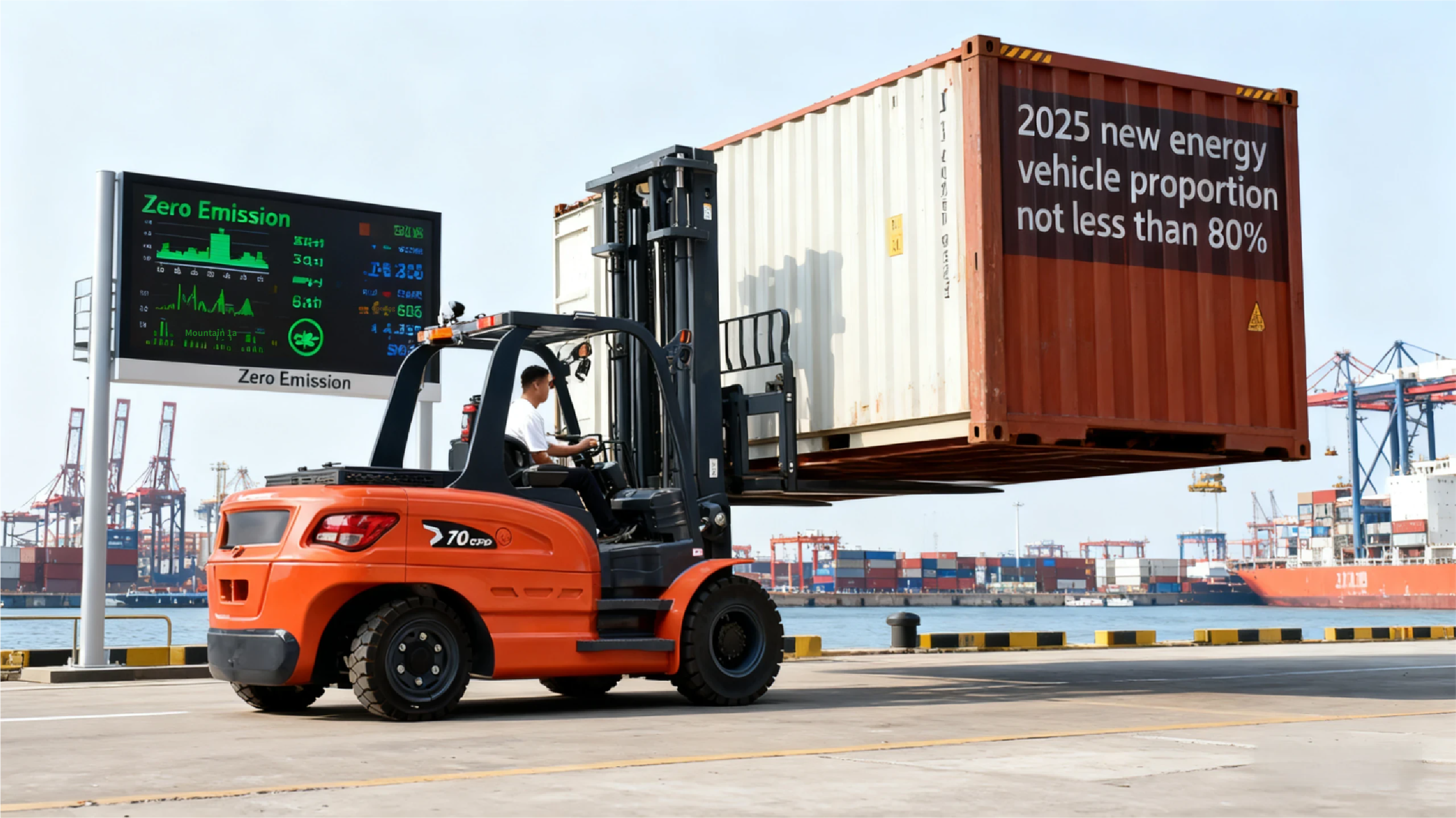
1. Starting in 2025, over 80% of newly added equipment in major Chinese ports must be new-energy vehicles
2. Global shipping giants (Maersk, COSCO) now treat carbon-intensity performance as a partnership requirement
3. By 2027, companies that do not meet green standards will lose access to the global supply chainIn other words:
Environmental compliance is now a survival threshold — not a bonus.
Qingdao Port shared an internal cost estimate widely referenced within the industry:
Continuing to use diesel forklifts means:
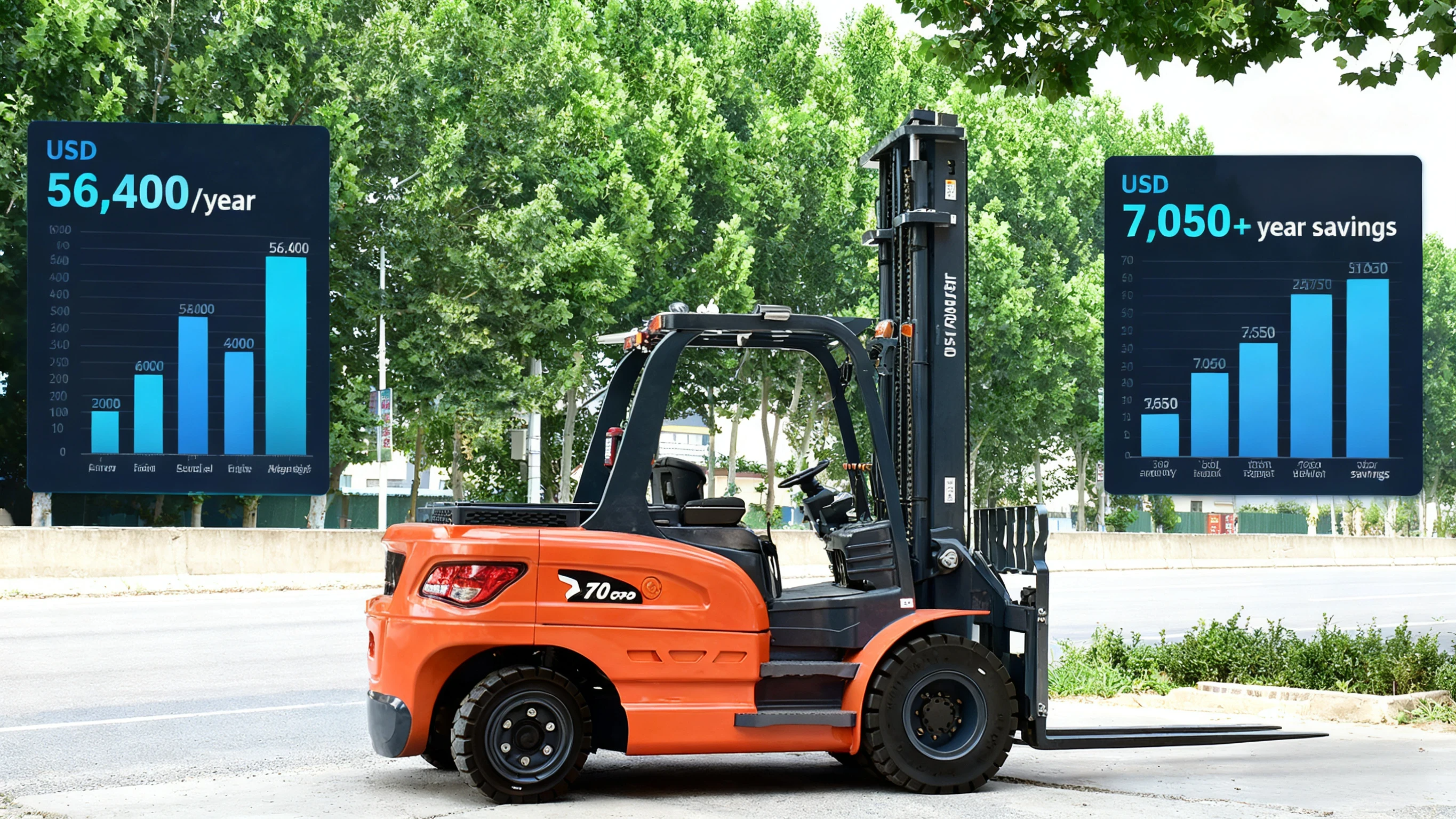
1. Approx. USD 56,400 per year spent on exhaust-treatment systems
2. Ongoing risk of production suspension during inspections
3. A 3-day shutdown can cost over USD 282,000
Switching to electric forklifts, however:
1. Eliminates emission-related risks
2. Qualifies the port for international green certifications
3. Ensures full compatibility with global green-logistics standards
After receiving Maersk’s “Green Partnership” certification,
Qingdao Port saw a 15% increase in new route orders in 2024.
This is not environmental charity.
This is a business decision.
Electric forklifts have become a required entry ticket to global logistics cooperation.
 (1).png)
02 Cost Savings Are No Longer Purchase Savings —
They Are Hard Profit on the Annual Financial Statement
If regulation is the red line, then operating cost is the bottom line.
Using Qingdao Port’s published data:
▍Energy Cost: A Clear and Significant Advantage
.png)
1. Daily fuel cost for an internal-combustion forklift: 185 RMB
2. Daily electricity cost for an electric forklift: 46 RMB
→ According to the port’s calculations,
each electric forklift saves approx. USD 7,050+ per year in energy costs.
▍Maintenance: Structure Determines the Winner
Electric forklifts have no engine or transmission.
Diesel forklifts rely on complex fuel systems, pumps and engines — all major failure points.
Qingdao Port reports:
200 electric forklifts reduced annual maintenance spending by approx. USD 169,200.▍Downtime Cost: The Most Expensive Factor for Airports
Chongqing Airport calculated the true impact:
1. One hour of diesel-forklift downtime → flight delay → USD 14,100+ loss
2. Electric forklifts show 65% lower failure rate
With smart-warning systems,
the airport reported zero forklift-related delays in 2024.
This is not “small savings.”
This is direct, guaranteed profit.
03 Extreme-Intensity Workload Verified
Electric Forklifts Can Now Handle the Hardest Logistics Environments
Ports and airports operate under the harshest possible conditions:
1. Zero tolerance for interruptions
2. Peak-time performance must be stable
3. Random failures can’t be allowed
4. Salt air, humidity, dust and large temperature swings test equipment constantly (1).png) Two industry benchmarks have already given the market full confidence:
Two industry benchmarks have already given the market full confidence:
▍Qingdao Port: 16 Hours of Continuous Operation
1. 1-hour fast charging
2. 3-minute battery swap
3. 40% increase in operational efficiency
4. Vessel stay time reduced by 2.8 hours
5. Capable of serving 2 additional ships per day
These are the numbers that ports care about most.
▍Chongqing Airport: 8 Flights Handled in 3 Peak Hours — Zero Errors
Electric forklifts provide:
1. Higher precision (≤5 cm)
2. Low noise around passenger zones
Even during peak-time continuous operations:
not a single delay was caused by forklifts throughout the entire year.
The conclusion is clear:
Electric forklifts don’t just replace diesel — they outperform them under maximum load.
04 What Industry Leaders Truly Value:
The “Future Capability” of Electric Forklifts (1).png) The most important insight from Qingdao Port and Chongqing Airport is not“electric forklifts are cheaper,”
The most important insight from Qingdao Port and Chongqing Airport is not“electric forklifts are cheaper,”
but that:
Diesel forklifts are no longer compatible with the future of intelligent logistics.Electric forklifts support:
1. Digital-twin system integration
2. AGV collaboration
3. Real-time 5G dispatching
4. Data-driven fleet management & onboard diagnostics
5. Unmanned and semi-unmanned operation platforms
Internal-combustion forklifts cannot achieve any of these.
Today:
1. Qingdao Port’s electric forklifts support Asia’s first fully automated terminal
2. Chongqing Airport has achieved end-to-end visibility and zero-error operations
Electric forklifts are not energy-saving equipment — they are the base layer of future logistics infrastructure.
05 Final Insight: Why Industry Leaders No Longer Hesitate
Because the real question is no longer: (1).png) “Should we switch to electric forklifts?”
“Should we switch to electric forklifts?”
but:
“If we don’t switch, how long can we survive?”
1. Tougher regulations
2. Stricter international cooperation standards
3. Rising operational costs
4. Higher efficiency requirements
5. Accelerating intelligent-logistics transformation
Industry leaders have already shown the answer with real action:
Choosing electric forklifts is not following a trend —
it is keeping up with the future.
And the earlier you switch, the faster you gain competitive certainty.
Our manager will contact you shortly.
To contact you about our products and services.
Copyright © Xingtai Beiqiang Machinery Manufacturing Factory. 2025.
Technical support:Echola