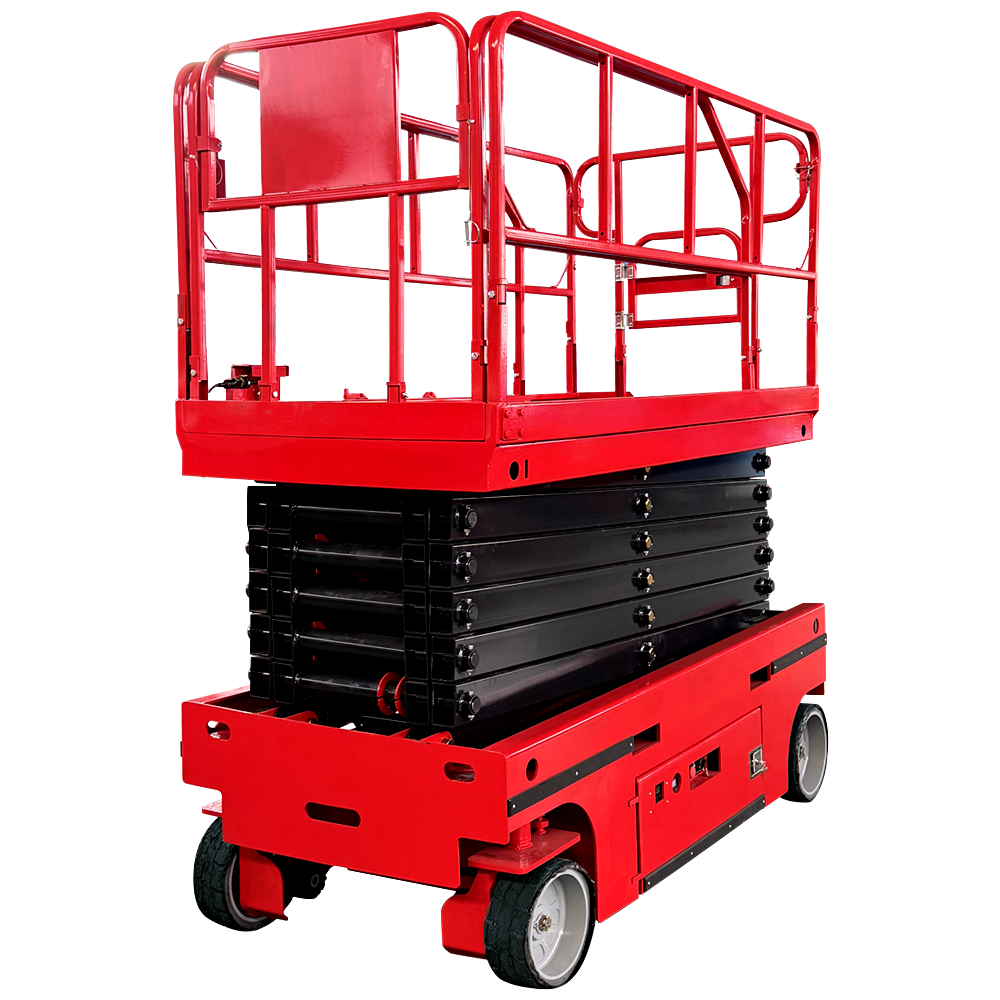


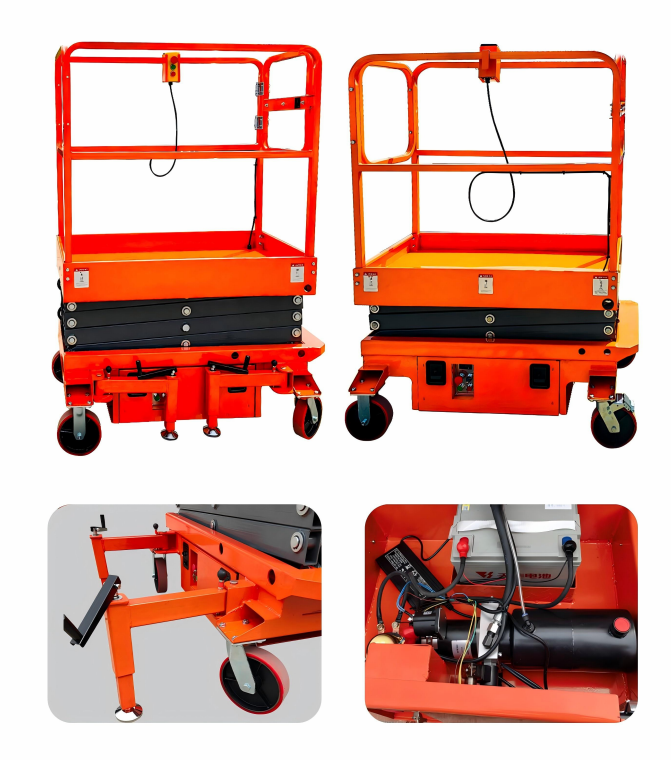
In facilities where space is at a premium and tasks require reliable, low-to-medium height access, standard large scissor lifts can be overkill and impractical. Enter the Push-Around Mini Scissor Lift with Platform Extension—a highly maneuverable, electrically-powered workhorse engineered to deliver safety and efficiency in confined environments.
What is a Push-Around Mini Scissor Lift with Extension?
This specialized equipment category combines three key features:
Push-Around Design: The lift lacks a self-propelled drive system. It is manually moved by the operator, similar to a large pallet jack. This makes it lightweight, mechanically simple, and ideal for smooth indoor floors.
Mini/Compact Scissor Mechanism: It utilizes a scaled-down, low-profile scissor system, often with a single lifting cylinder. Its retracted height is minimal (sometimes under 6 inches), allowing it to roll under equipment or through standard doorways.
Platform Extension Deck: The defining feature is a manual or mechanically-assisted extension deck. This deck slides outward, typically by 1 to 3 feet, providing crucial horizontal reach over obstacles like machinery, racks, or furniture without moving the entire lift base.
Core Advantages: Why Choose It?
Unmatched Maneuverability: Its compact size and light weight allow easy navigation through narrow warehouse aisles, retail shelves, equipment rooms, or production floors. It can fit through standard doorways and freight elevators.
Strategic Reach of the Extension Deck: This feature is a game-changer. Operators can position the lift in a stable location and extend only the deck to access hard-to-reach areas—over production lines, deep into shelving, or above fixed equipment. This reduces the need for risky and time-consuming repositioning.
Zero Emissions & Low Noise: As a purely electric machine, it operates quietly with no emissions, making it perfect for environmentally sensitive areas like food plants, labs, museums, or active offices.
Cost-Effective & Low Maintenance: With no complex drive motors or transmissions, it typically has a lower purchase/rental cost and simpler maintenance than self-propelled scissor lifts.
Inherent Safety & Stability: Despite its size, it inherits the stability of standard scissor lifts. A wide base and robust scissor structure provide a secure work platform, even with the deck extended under load.
Primary Applications
This versatile platform is a "secret weapon" across industries:
Warehousing & Logistics: Ideal for inventory counts, label changes, or light maintenance in narrow VNA (Very Narrow Aisle) racking. The deck can extend into the rack while the lift body remains in the aisle.
Retail & Commercial Facilities: Used for ceiling light replacement, sprinkler head inspections, sign hanging, or decorations. It moves easily between shelves and customer aisles.
Light Manufacturing & Assembly Lines: Perfect for maintenance over equipment, repairs across conveyors, or installing components over fixed workstations.
Equipment Rooms & Utilities: Enables work over dense machinery like boilers, piping, or HVAC units. The extension deck can bridge gaps to the optimal work point.
Venues & Property Maintenance: Useful for cleaning high windows, maintaining stage lighting, or accessing awkward high corners.
Key Selection Criteria
Working Height & Extension Reach: Determine the maximum platform height (with deck retracted) and the required horizontal extension. Together, they define the effective work envelope.
Platform Size & Capacity: Check the dimensions and load ratings of both the main platform and the extension deck. Ensure they accommodate the worker and tools.
Access Dimensions: Note the unit's overall width (to clear aisles) and stowed height (to clear doors or fit under machinery).
Extension Mechanism: Understand if the deck slides manually or via an assist mechanism (e.g., a crank). Check its stability and locking when fully extended and loaded.
Power & Runtime: Verify battery voltage and estimated continuous run-time to ensure it meets shift requirements.
Essential Safety Practices
Always Lower Before Moving: Only move the unit when the platform is fully lowered.
Lock the Base Before Extending: Ensure casters or stabilizers are locked before operating the extension deck.
Never Exceed Load Ratings: Strictly adhere to the rated capacity for both the main platform and the extension deck.
Mind the Center of Gravity: Avoid placing excessive weight at the edge of the extended deck or applying undue force.
Maintain a Clean Worksite: Ensure the floor is level and free of debris to prevent tripping or instability when pushing the lift.
Conclusion: The Right Tool for a Specific Challenge
The push-around mini scissor lift with an extension deck isn't meant to replace large self-propelled lifts. Instead, it perfectly fills a critical niche. It embodies the engineering philosophy of "just right"—providing the ideal tool for tasks that don't require extreme height but desperately need mobility, compactness, and strategic horizontal reach.
For any facility manager or maintenance team needing to perform safe, efficient work at height in constrained spaces, investing in this equipment is often the smartest and most economical decision to boost productivity, improve ergonomics, and tackle previously "awkward" jobs. It proves that the best solutions are often those that are precisely designed and purpose-focused.
Our manager will contact you shortly.
To contact you about our products and services.


Copyright © Xingtai Beiqiang Machinery Manufacturing Factory. 2025.
Technical support:Echola